
What Hand-Eye Coordination Tells You About Your Child
Have you ever watched your kiddo work hard at their handwriting or miss a catch by just a bit, and wondered, “Should I be concerned that these tasks aren’t coming easier to them?”
The experience of many everyday activities, like writing a thank-you note to Grandma and Grandpa and tossing a ball with Dad, is shaped by the development of hand-eye coordination. This foundational skill helps kids use visual information to create smooth, purposeful motor responses in real time. When it’s still developing, or if its development has been impaired,tasks require more effort.
And hey, that’s okay! Hand-eye coordination is a skill that grows over time. With intentional practice and the right kind of support, it strengthens like a muscle. All of a sudden, you’ll realize, “Oh my goodness, they’re catching most balls that are thrown!" or “I can’t believe it! I can read what they wrote!”
What Is Hand-Eye Coordination?
Hand-eye coordination, a component of visual motor integration, is the ability to respond to visual input efficiently and with precision—whether that “visual input” is a ball in the air or the lines on a piece of paper. It’s the beautiful teamwork between our hands and eyes that helps us move through tasks with ease.
This connection between our hands and eyes helps children judge distance, timing, direction, and speed as they explore their world. It supports their aim when they’re reaching for objects on a shelf, cutting along a line, coloring the parts of a picture, guiding a pencil across paper, and even when playing tag with friends!
Why Hand-Eye Coordination Matters
Hand-eye coordination plays a big role in how children move through their day, both in school and in play.
When this skill is working smoothly, tasks are easier and take less energy. When it’s still developing or impaired, kids have to work harder to keep up, even when they’re already trying their best.
The good news is that there are gentle, supportive ways to build these skills and make your child’s daily life easier, one success at a time.
How Hand-Eye Coordination Shows Up Every Day
Here are a few ways your child can practice hand-eye coordination skills every day.
Basic Classroom Skills and Participation
Hand-eye coordination helps children with tasks like copying from the board and using classroom tools like scissors, glue, manipulatives, pencil sharpeners, tongs, paper clips, and staplers. A child may understand a lesson being taught, but struggle to show what they know through various hands-on learning activities, if coordinating vision and movement takes extra effort and causes frustration.
Handwriting and Fine Motor Tasks
Difficulties with eye–hand coordination often become most evident in a child’s handwriting. Impairment or weakness impacts kids’ ability to form letters, place them on provided lines or within boundaries, size them accurately, space between words, and write legibly. Impaired hand-eye coordination also affects a child’s independence with self-care activities of everyday life, such as buttoning shirts, zipping coats, tying shoes, and using utensils.
Academic Work and Spatial Awareness
Because classroom work requires precise spatial awareness and controlled movement, eye–hand coordination plays an essential role in daily academics, including tasks in math, art, and language arts. It helps a child connect lines and shapes to draw simple, identifiable pictures, align numbers accurately in math problems, form letters with correct orientation (reducing reversals), and keep written work organized within the lines and margins of the page.
Play, Sports, and Movement
Playground games and sports rely on skills like catching, throwing, hitting targets, and using equipment. When the objects coming at them during these activities feel unpredictable, children may avoid group play—not because they aren’t interested, but because it's hard.
Hand-Eye Coordination Develops in Childhood
The development of hand-eye coordination begins early and continues to refine throughout childhood. While every child’s timeline is different, here are some general patterns to look for:
Ages 2–4: Toddlers explore stacking, scribbling, puzzles, and basic use of scissors (such as with Play-Doh!)
Ages 5–6: Children demonstrate more control and precision with coloring, drawing, letter formation, and simple ball play
Ages 7–9: Kids’ movements during writing, crafts, and sports are smoother, more automatic, and more precise
Ages 10–12: Preteens show increased speed, accuracy, and stamina, and can even multitask by organizing different motions with the right and left sides of their body in activities that require bilateral coordination
When a skill feels harder for your child than it does for other kids their age, or than it did for their older siblings, a little extra support can restore their confidence and make the movements required in everyday tasks feel easier.
Signs Your Child May Benefit from Extra Support
These signs do not indicate that something is wrong. Rather, they highlight areas where skills are still developing. This is an important window for targeted support, allowing the right strategies to be introduced to strengthen and support continued skill growth. Parents and teachers may observe:
Avoidance of handwriting or drawing
Messy or slow handwriting
An interesting pen
Difficulty with scissors, puzzles, or building toys
Trouble catching a ball or hitting a target
Frequent frustration with fine motor tasks
Inconsistent letter sizing or spacing
“Clumsiness” during play
What Hand-Eye Coordination Challenges Tell You
When you notice the signs that your child may be struggling with hand-eye coordination, here are a few things you can infer.
Fine Motor and Visual Planning Skills
Children may struggle to guide their hands accurately, despite physical strength,, which can affect writing and precision within tasks.
Planning and Follow-Through
Challenges can overlap with motor planning and attention, making it harder to learn new movement patterns or organize within multi-step tasks.
When difficulty with attention, planning, and follow-through shows up across several parts of your child’s day, it may be worth looking more closely at the subtle signs that your child is struggling to focus.
Emotional Regulation and Confidence
When effort doesn’t lead to success, confidence can take a hit. Even while giving it their best shot, children may become easily upset or start to avoid tasks, further impeding their self-efficacy and the way they feel about themselves and school.
Specifically, Feder & Majnemer (2007) explain the impact of reduced eye-hand coordination in the context of handwriting: “Failure to attain handwriting competency during the school-age years often has far-reaching negative effects on both academic success and self-esteem.” The good news is, there are some great ways to improve hand-eye coordination that your kiddo will love!
10 Playful Ways to Strengthen Hand-Eye Coordination at Home
These fine motor activities build skills naturally and help your child develop while having fun:
#1: Balloon volleyball
Slow-moving balloons give kids extra time to track what they see and plan their movement, making this a great low-pressure way to practice coordination and timing.
#2: Sock toss into a laundry basket
Tossing rolled-up socks into a basket helps build accuracy and depth perception. Start close to the basket so success comes quickly, then gradually increase the distance as confidence grows.
#3: Wall targets with painter’s tape
Create shapes, letters, or numbers on the wall and have your child toss a soft ball or beanbag to the target you call out. This challenges visual attention and coordination, as well as motor planning..
#4: Flashlight tag
Shine a flashlight on the wall and have your child “catch” the light with their hand or a fly swatter. It’s engaging and great for visual tracking!
#5: Dot-to-dot and maze activities
These worksheets build visual-motor integration, motor planning, and precision, which support handwriting and fine-motor tasks.
#6: Sticker pictures
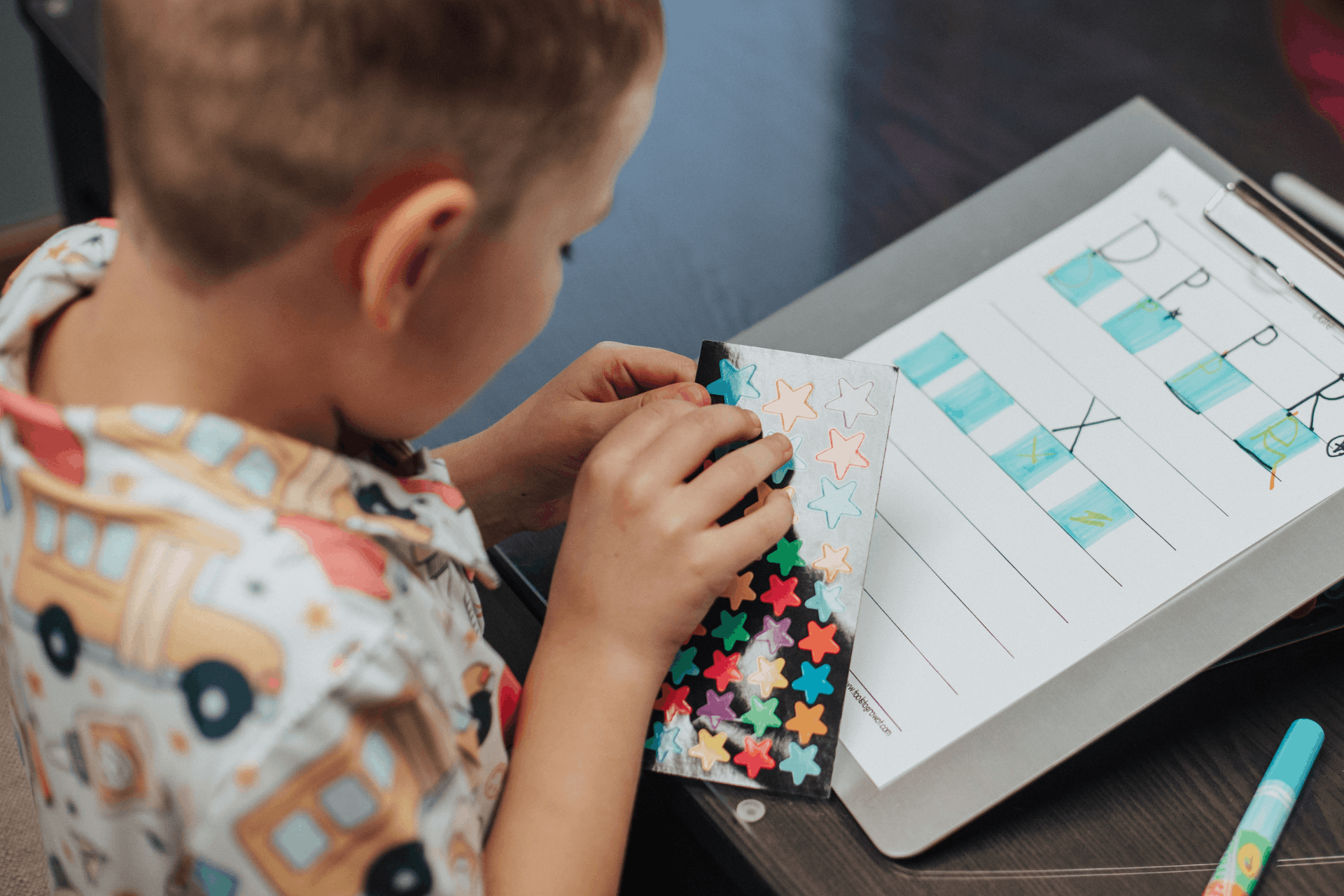
Peeling and placing stickers with accuracy requires precision and finger isolation, while the eyes guide exact placement. It’s an easy, quiet activity that packs a big developmental punch.
#7: Lacing cards or bead stringing
Threading beads or laces helps improve accuracy, motor planning, and bilateral coordination, especially for kids who benefit from hands-on repetition.
#8: Cutting games
Turn cutting practiceinto a game by outlining paths to follow, like “cut the road to the castle” or “help the snake find its way.” Start with straight lines, then move to curves.
#9: Copycat block builds
Build a simple structure and have your child recreate it. This strengthens visual perception and spatial awareness while developing visual-motor planning.
#10: Outdoor chalk games
Drawing large shapes, targets, or hopscotch paths on the driveway lets kids practice coordination with larger movements first, which makes fine motor practice easier later.
Signs It’s Time to Seek Support for Hand-Eye Coordination Development
You know your child best. If certain tasks consistently feel more difficult than expected, or if increased effort does not translate into greater ease over time, it may be beneficial to supplement development with structured, engaging skill-building activities. Additional support may be worth considering if:
Writing is consistently difficult or exhausting.
Homework causes frequent frustration.
Skills aren’t improving over time.
Teachers have expressed concerns.
Avoidance is becoming more common.
Support is not about labeling; it is about equipping your child with effective tools. Structured handwriting intervention, hand-strengthening activities, andself-regulation strategies can help make daily tasks more manageable while supporting continued growth in confidence.
Occupational Therapy Helps Hand-Eye Coordination Click
When children experience frustration with hand-eye coordination, the solution is rarely a matter of “trying harder.” Pediatric occupational therapy addresses underlying skill areas by strengthening foundational components such as visual tracking, motor planning, fine motor precision, and handwriting readiness through supportive, achievable interventions.
Therapy is individualized and engaging, helping children recognize their capabilities and build confidence. Families exploringoccupational therapy servicesoften find that this additional support unlocks awesome skills and fosters greater independence and self-assurance.
Frequently Asked Questions About Hand-Eye Coordination
At what age do kids develop hand-eye coordination?
Hand-eye coordination develops from infancy through childhood, with big growth during the early school years. Every child progresses at their own pace.
What causes poor hand-eye coordination in children?
Poor hand-eye coordination can be influenced by a variety of factors, including a child’s visual processing skills, hand strength, motor planning abilities, attention, and overall motor development. Pediatric occupational therapycan target the problem to increase visual motor integration in fun and engaging ways.
How can I improve my child’s hand-eye coordination?
Play is powerful! Ball games, puzzles, drawing, coloring, and hands-on crafts naturally build skills without pressure.
Does ADHD affect hand-eye coordination?
For some children, yes. Challenges with attention can make eye coordination more difficult, but these skills can still absolutely improve with the right support.
Help Your Child Grow With Confidence and Joy: Work with Ashlee Schmitt, MOT, OTR/L

If tasks requiring hand-eye coordination are causing frustration for your little one and you’re ready for some extra support, occupational therapy will help. Ashlee Schmitt, MOT, OTR/L, brings a joyful, personalized approach to every session, helping children build coordination and confidence in what they can achieve. Interested in learning whether OT could support your child’s hand-eye coordination? Let’s talk.